


Home AED Guide 2026: Pricing, Models & Installation
Is It Worth Installing an AED at Home? Here's What You Need to Know
Not sure which model is right for your family?
Every minute counts in a cardiac arrest.
How far is the nearest public AED from your home?
Does Your Home Really Need an AED?
AEDs are widely available in public venues across Taiwan — MRT stations, airports, shopping centers — but for most people, there isn't a single device within 500 meters of their home.
The critical window after cardiac arrest is 4 minutes. The average ambulance response time is over 10 minutes. If an emergency happens at home, that gap needs to be filled — by you.
The following three household situations make a home AED especially worth considering:
- Elderly family members at home: Cardiac risk increases significantly after age 65
- Family history of cardiovascular disease or arrhythmia: Higher risk of sudden onset means better to be prepared
- Living far from medical services: Mountain areas, outlying islands, and remote communities — every minute is more critical
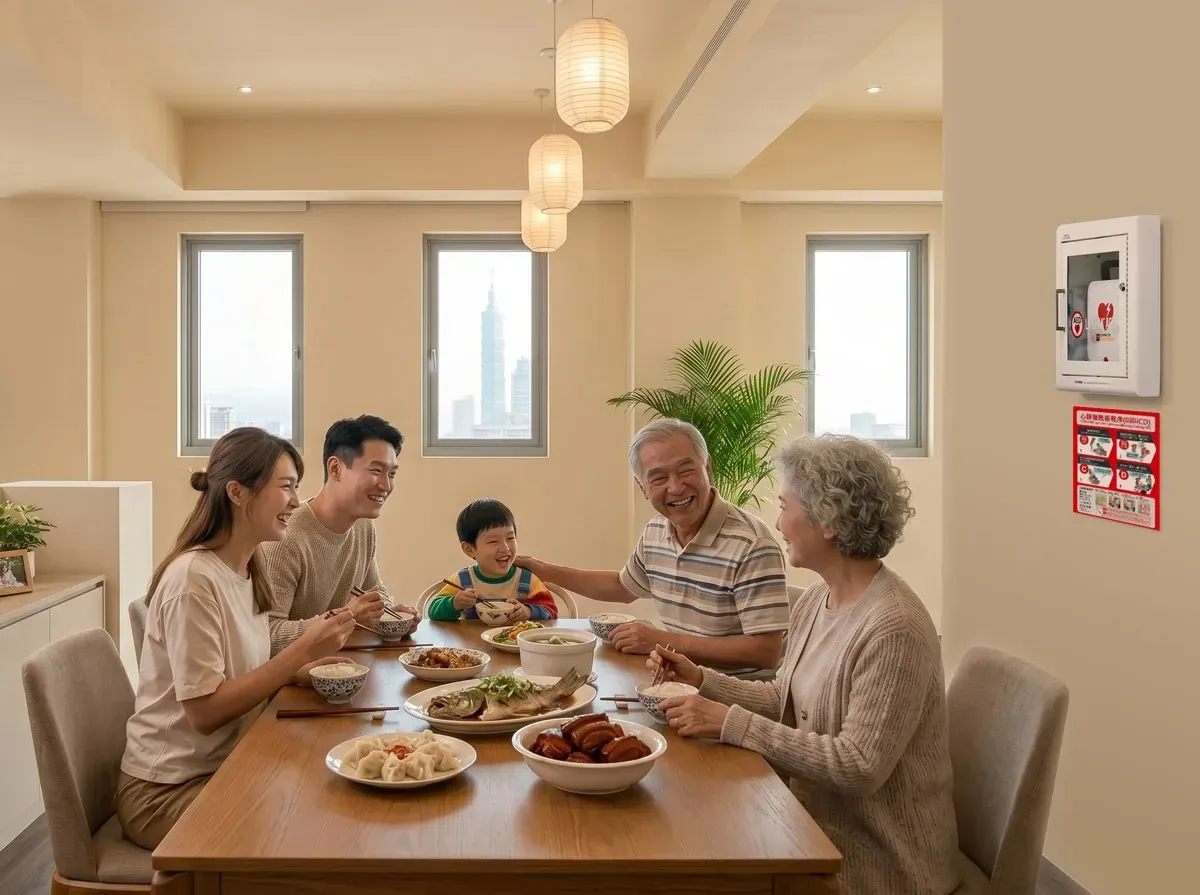
Home AED Price Comparison in Taiwan (2026 Update)
The following is a reference price guide for commonly available AED brands approved by Taiwan's Ministry of Health and Welfare:
| Brand / Model | Price Range (NTD) | Notes |
|---|---|---|
| LIFEPAK CR2 | Approx. NT$80,000–150,000 | Intuitive and easy to use, with smart management features. Available in USB, Wi-Fi, and 4G versions. |
| Defibtech DT2 | Approx. NT$130,000 | Screen-guided operation |
| Philip FRX | Approx. NT$120,000 | Compact and lightweight design |
| Zoll AED Plus | Approx. NT$100,000 | Features real-time CPR quality feedback |
| NANOOM HeartResQ | Approx. NT$85,000 | Used by Taipei Metro and many government agencies |
💡 Prices vary depending on accessories (electrode pads, battery, wall cabinet), connectivity options, and warranty period. We recommend requesting an all-inclusive quote that covers consumables, so you can make a true total-cost comparison.
Beyond the Device: What Other Costs Should You Budget For?
An AED is a long-term investment. Consumable costs beyond the main unit should be factored into your total budget:
| Item | Price Range (NTD) | Recommended Replacement Interval |
|---|---|---|
| Electrode pads | Approx. NT$3,000–9,000 | Approx. every 2–4 years; must be replaced once opened or used |
| Battery | Approx. NT$5,000–15,000 | Approx. every 3–5 years |
| AED storage cabinet / wall-mounted case | Approx. NT$8,000–25,000 | Features an alarm function; helps protect and organize the device |
KLUX provides a consumable expiry reminder service. After purchase, you don't need to track expiry dates yourself — we will proactively notify you and help arrange replacement when the time comes.
Where to Place and How to Maintain a Home AED
Recommended placement:
- Living room or entryway: Most accessible location — avoids the risk of not finding it in an emergency
- Near the main entrance or stairway: Easy for both family members and first responders to access quickly
- Away from direct sunlight, bathrooms, and high-temperature environments: Protects device longevity
Routine maintenance:
All commercially available AEDs have a built-in self-diagnostic function. If an anomaly is detected, the device will alert you with a sound, flashing light, or an indicator on the panel (O or X). Simply notify your AED provider and they will arrange inspection or repair as soon as possible.
After installing an AED, encourage all family members to learn CPR & AED skills — so that in an emergency, everyone knows not just where the device is, but how to use it.
Could You Be Sued for Helping?
Do You Need a Certificate to Use an AED?
Under Article 14-2 of Taiwan's Emergency Medical Services Act, members of the public who use an AED in good faith during an emergency are exempt from both criminal and civil liability — regardless of whether they hold a first aid certificate. The law clearly protects all rescuers.
The government has deployed AEDs widely in public areas and actively promotes first aid education. Anyone who knows the Call-Call-Push-Shock steps has the potential to save a life — no certification required.
Why Choose KLUX?
- Authorized distributor of US and European brands: KLUX distributes LIFEPAK CR2, LIFEPAK 1000, and other Physio-Control products — with direct access to manufacturer technical support
- Over 17 years in the AED industry since 2009, with 10,000+ units serviced: from leading tech and financial enterprises and Taipei Metro to individual households — proven experience across every setting
- Four service locations across Taiwan: Taipei, Taichung, Kaohsiung, and Hualien. Our service footprint extends beyond the Taiwan mainland to Penghu, Kinmen, and Matsu. We have built Taiwan's most comprehensive inspection network — from rural schools and mountain scenic areas to remote island agencies — guided at every step by a "life first" principle.
Not sure which model is right for your family? Contact KLUX directly.
FAQ
What is the difference between a home AED and a public-access AED?
The device itself is the same — the exact same equipment is widely used in businesses and public venues. "Home AED" simply refers to an AED purchased by an individual or family, primarily for use in household emergencies. The same selection criteria apply: choose a brand with a valid Ministry of Health and Welfare license.
Can an AED be used on a child?
AEDs on the market fall into two categories. Some require pediatric-specific electrode pads to be used on children. Others are newer models designed for both adults and children — simply follow the voice prompts to switch to pediatric mode. Please confirm the model's specifications with your AED provider.
If the AED just sits unused for a long time, will it malfunction?
All commercially available AEDs have a built-in self-diagnostic function. If an anomaly is detected, the device will alert you with a sound, a flashing light, or an indicator on the panel (O or X). Simply notify your AED provider and they will arrange inspection or repair as soon as possible.
Beyond the main unit, what else needs to be maintained?
In addition to the main unit, consumables need to be replaced periodically — typically every 2–4 years for electrode pads and every 3–5 years for the battery, depending on the brand. KLUX clients receive our consumable expiry reminder service: after purchase, you don't need to track expiry dates yourself — we will proactively notify you and help arrange replacement when the time comes.